


Supporting data-driven EV infrastructure planning in Vallée de la Seine
The Challenge
The Vallée de la Seine region faced several challenges when planning the deployment of EV charging infrastructure. Data relevant to infrastructure planning was fragmented across multiple sources and formats, making comprehensive analysis difficult. In addition, the lack of reliable demand forecasting created uncertainty around the optimal locations for charging stations, making it challenging to identify priority deployment areas.
Decision-makers also needed robust, data-driven evidence to justify infrastructure investments to elected officials and other public stakeholders. At the same time, limited public budgets increased the pressure to maximise the return on investment by ensuring that charging infrastructure was deployed where it would deliver the greatest long-term impact.
The Solution
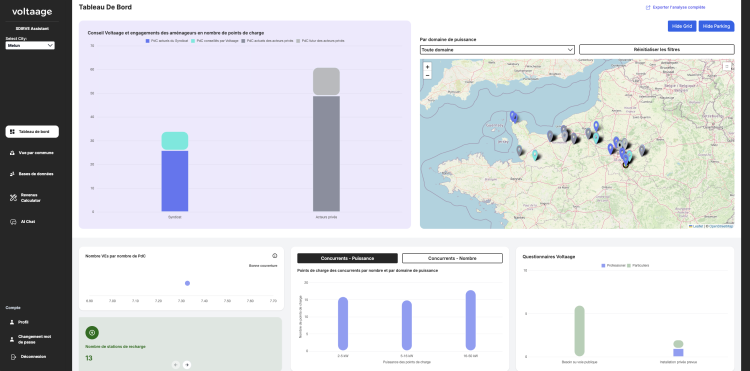
Voltaage applied its AI-powered planning platform to analyse geospatial information, mobility flows, charging behaviour and other relevant datasets. The platform generated data-driven recommendations on where charging infrastructure should be deployed to maximise accessibility, utilisation, and investment efficiency, supporting strategic regional planning. By consolidating information from multiple sources, the platform enables stakeholders to identify optimal charging locations, forecast future demand, and support investment decisions with robust evidence.
Through interactive geospatial mapping and AI-powered analytics, users can visualise key indicators - including population density, EV adoption rates and infrastructure coverage - to identify high-potential locations. In addition, the solution provides utilisation forecasts, revenue and return-on-investment estimates and decision-ready reports, helping public authorities prioritise investments and communicate recommendations effectively to stakeholders.
Making an impact
The project transformed the way the Vallée de la Seine region - where 22 municipalities were analysed and 168 potential charging points identified - plans and prioritises EV charging infrastructure by replacing fragmented, manual planning processes with a unified, data-driven approach. Previously, transport and infrastructure data was distributed across multiple incompatible systems, making comprehensive analysis both complex and time-consuming. By integrating these datasets into a single platform with real-time updates, planners gained a comprehensive view of existing infrastructure, mobility patterns and future charging demand.
The introduction of AI-powered analytics enabled planners to identify optimal charging locations with greater confidence, replacing intuition-based decision-making with evidence-based recommendations supported by confidence scores. Analyses that previously required weeks of manual work could now be completed in minutes, allowing decision-makers to evaluate multiple deployment scenarios more efficiently and respond faster to changing planning needs.
The solution also strengthened communication with elected officials and other stakeholders by generating robust, data-backed reports to support investment decisions. In addition, ongoing performance monitoring enables authorities to assess infrastructure effectiveness over time and continuously optimise future deployments.

Lessons learnt
Close collaboration between technology providers and regional authorities was essential to ensure that the platform addressed real planning needs and produced actionable insights for decision-makers.
The project demonstrated that combining AI with geospatial analytics and integrated mobility datasets can significantly improve long-term EV charging infrastructure planning. By replacing fragmented data analysis with a unified, evidence-based approach, planners were able to identify priority investment locations more confidently and reduce the uncertainty associated with traditional planning methods.
The pilot also highlighted the value of predictive, data-driven planning over reactive decision-making. Incorporating real mobility patterns, charging infrastructure data and future demand forecasts enables authorities to optimise public investment, better anticipate future infrastructure needs and maximise the long-term utilisation of charging networks. Finally, continuous performance monitoring provides valuable feedback that can support future planning decisions and the ongoing optimisation of charging infrastructure as EV adoption evolves.