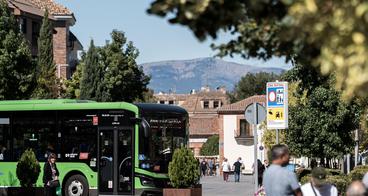


Addressing overcrowded public transport in Sofia and Bucharest

Supported by EIT Urban Mobility
The Challenge
In high-frequency urban bus networks, overcrowding and bus bunching are common, leading to denied boarding, reduced seating availability, longer dwell times and unreliable journeys. These issues are particularly acute on busy corridors and inner-city routes in large cities such as Sofia and Bucharest, where demand fluctuates significantly throughout the day.
Operationally, most networks rely primarily on vehicle location (AVL/GTFS) data and static timetables. While this enabled basic punctuality monitoring, it provided no visibility of passenger crowding, meaning control rooms could not distinguish between an empty late bus and an overcrowded one. As a result, interventions such as holding vehicles or adjusting headways were often ineffective or counterproductive, sometimes worsening passenger experience by delaying already crowded services.
Sofia (Bulgaria) faces emerging urban mobility challenges, including the need to align public transport services with dynamic travel demand and raise overall service quality. Its dispersed settlement pattern and limited service frequency struggle to keep pace with rapidly increasing commuter flows. Whilst Bucharest’s (Romania) public transport suffers from congestion-induced delays, irregular service, and insufficient network coverage. The city struggles to improve the public transport reliability and its modal share, due to limited alignment between public transport services and actual demand.
The Solution
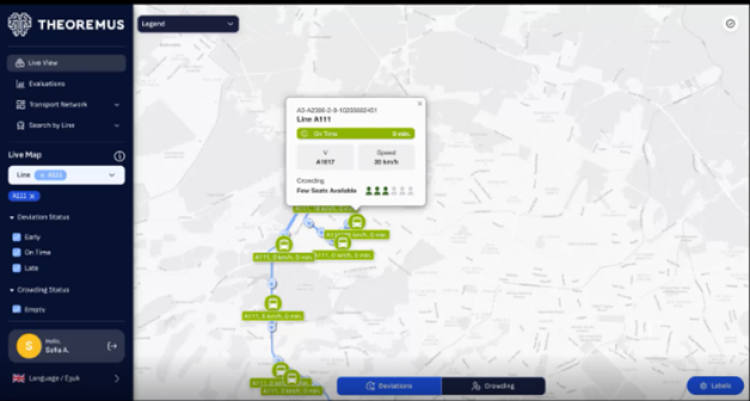
The Theoremus Bus Data Platform / Bus Crowding Management System (BCMS) was developed to close the critical gap between operational monitoring and passenger demand management in urban bus networks. The solution combines edge-based passenger crowding analytics, real-time GTFS/AVL data, and an intelligent intervention engine into a single, operationally focused platform that supports both day-to-day control and longer-term planning.
At the core of the solution is an AI crowding module deployed on board vehicles, which estimates passenger load using existing CCTV feeds. Crowding data is fused in real time with vehicle location, speed and schedule information, creating a unified, network-wide operational view that previously did not exist.
The platform delivers this intelligence through a web-based dashboard that offers multiple analytic layers: network overview, line efficiency, segment-level punctuality and crowding, speed analysis and historical performance trends. These tools enable operators to identify where and when overcrowding, early running or delays occur and to understand how these issues vary by time of day.
Making an impact
The deployed solution delivered measurable operational and economic benefits through live pilots and validated simulations in Sofia and Bucharest.
Across both pilots, the intervention algorithm was evaluated using Transport for London’s generalised journey time framework. Compared with a no-control baseline, optimal interventions reduced passengers' perceived journey time by approximately 15%, reflecting improvements in crowding, waiting time and service regularity.
This demonstrates that BCMS enables operators to extract more value from existing fleets without adding vehicles, supporting cost-efficient capacity optimisation. The platform was validated on 20+ buses per pilot, with full integration of AVL, schedules and crowding data into control-room workflows. Beyond the pilots, the platform has also been tested in a 3-month trial in Miami and an active pilot in Debrecen, confirming transferability across networks.
Lessons learnt
Several operational and institutional challenges emerged during deployment, providing important lessons for future scale-up. A key limitation concerned legal and regulatory constraints on real-time bus interventions. While the BCMS can technically recommend actions such as holding vehicles or adjusting headways, the authority to mandate or automate these actions often sits above operators and agencies, at the level of transport authorities or regulatory bodies. In some cases, intervention rules are embedded in labour agreements, safety regulations, or traffic laws, limiting how recommendations can be applied in live operations. This highlighted the need to engage policymakers early and to position BCMS as a decision-support tool, rather than an automated control system, unless governance frameworks are updated.
From a technical perspective, data heterogeneity was a recurring challenge. Differences in AVL formats, data quality, and update frequencies across cities required additional effort in defining and validating interfaces. This reinforced the importance of early technical workshops, clear data specifications, and iterative testing with local teams. Another learning was that control-room users value simplicity and clarity over model complexity; dashboards and recommendations had to be carefully designed to align with real operational workflows.