

Nudging cycling culture towards change in Croatia

Supported by EIT Urban Mobility
The Challenge
In Zagreb, similar to many other cities in Europe, commuting to work by private car remains the default travel option for many residents. The negative impacts of widespread car dependency are well-known: rising greenhouse gas emissions, traffic congestion, air pollution, and adverse effects on public health.
Despite improving conditions and infrastructure for cycling, many citizens continue to opt for private vehicles for their daily commute. This is partly due to a lack of top-down incentives for behavioural change. Without meaningful incentives to motivate modal shifts, cars remain the dominant choice for many commuters.
In this sense, municipalities and employers face a similar challenge: encouraging employees and residents shift from cars to bicycles. Organisations lack reliable tools to monitor employees’ and residents’ travel behaviour, create measurable ESG targets around commuting, and reward those who make greener travel choices. This lack of reliable data makes it difficult for organisations to nudge individuals towards more sustainable travel choices.
The Solution
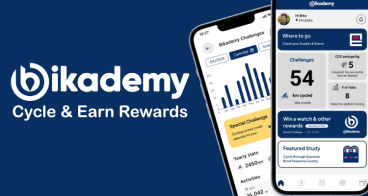
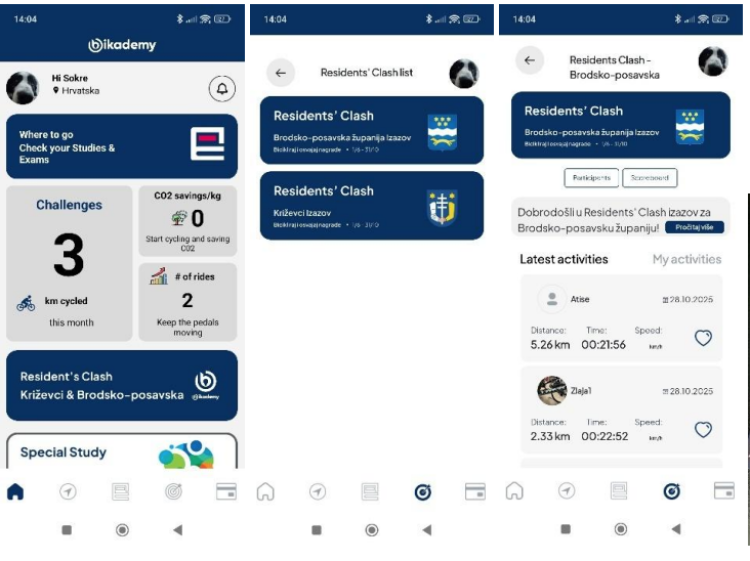
In order to promote daily cycling in Croatia, Bikademy developed a mobile platform that encourages everyday bicycle use through gamified mechanisms such as real-time tracking, rewards and community competition. Building on its existing features, the platform expanded with two new tools aimed specifically at motivating citizens to choose cycling as their daily commute option. The new features are Residents’ Clash, which was tested with Brod-Posavina County and City of Križevci, and Employees’ Clash, piloted in partnership with the Zagreb-based company Solvership.
A targeted communication campaign was essential to increasing participation across all three locations. Localised online campaigns, custom landing pages and community ambassadors were implemented to engage residents, while at Solvership, the HR and communications team played an active role in onboarding employees and sustaining motivation through regular progress updates and internal recognition of top participants.
Beyond individual behaviour change, the platform also addressed a growing institutional need. As companies and municipalities across Europe face increasing pressure to demonstrate progress on ESG commitments, reliable data on employee and resident travel behaviour has become increasingly valuable. Bikademy's real-time dashboards and monthly reports included metrics on rides, distances and CO₂ savings, which gave participating organisations tangible data to support their sustainability reporting.
Making an impact
Bikademy’s two new features were tested across three locations in Croatia. The project successfully onboarded 1,400 users, supported by a targeted communication campaign involving local ambassadors, digital outreach and employer engagement. During the pilot, participants recorded 5,482 rides and cycled a combined distance of 59,842 kilometres.
Compared to equivalent car travel, these journeys resulted in an estimated reduction of 5.98 tonnes of CO₂ emissions, demonstrating the potential of gamified behavioural change tools to support more sustainable commuting habits. The strong participation levels achieved across both public and private sector pilots suggest that cycling incentive programmes can be successfully deployed in a variety of organisational contexts.
Beyond the environmental impact, the project also demonstrated commercial viability. During the implementation period, Bikademy acquired new clients. The pilot also generated interest from several larger organisations and municipalities, including the City of Zagreb, Kaufland, Glovo, Krapina-Zagorje County and Koprivnica-Križevci County, highlighting the potential for further scaling.

Lessons learnt
A key takeaway from the pilot was the importance of community participation. Across all three locations, digital campaigns, local ambassadors, press outreach and close coordination with municipality communications teams were all crucial to drive uptake. This serves as a helpful reminder that the success of behavioural change depends on the strength of their rollout as much as their technology.
An important design feature was the separation of categories based on distance and gender, as it made the competition fairer and more inclusive, lowering barriers of entry for less experienced cyclists, which helps to sustain long-term participation.
For future implementations, the platform's gamified approach could be adapted to support other forms of sustainable mobility, including other micromobility, walking, public transport and multimodal journeys, allowing organisations to encourage a wider range of sustainable travel behaviours.
The Bikademy platform has strong potential for replicability in other locations, given that no additional infrastructure was required beyond the digital app itself.