

Improving last-mile logistics in Braga through data and collaboration
Supported by EIT Urban Mobility
The Challenge
Braga’s historic city centre faces acute last-mile logistics challenges due to its dense urban fabric, narrow streets, high pedestrian activity and limited loading and unloading capacity. The growth of e-commerce and urban deliveries has intensified freight movements within the historic core, where space is already highly constrained and competing uses of public space are frequent.
Unlike lower-density cities, Braga’s logistics challenge is concentrated in a compact historic environment where accessibility is limited and regulatory constraints are stronger. Commercial vehicles experience low average speeds, frequent stopping conflicts and a high incidence of illegal or unregulated stopping, all of which contribute to congestion, increased emissions and reduced public space quality. These issues also directly affect the daily operations of local retailers and the attractiveness of the city centre.
Before the pilot, the municipality lacked an integrated, data-driven understanding of logistics flows, delivery patterns and freight-related pressure points. Information on where and when delivery activity was concentrated was fragmented, making it difficult to identify optimal intervention areas or assess how to reduce heavy vehicle penetration into the historic centre.
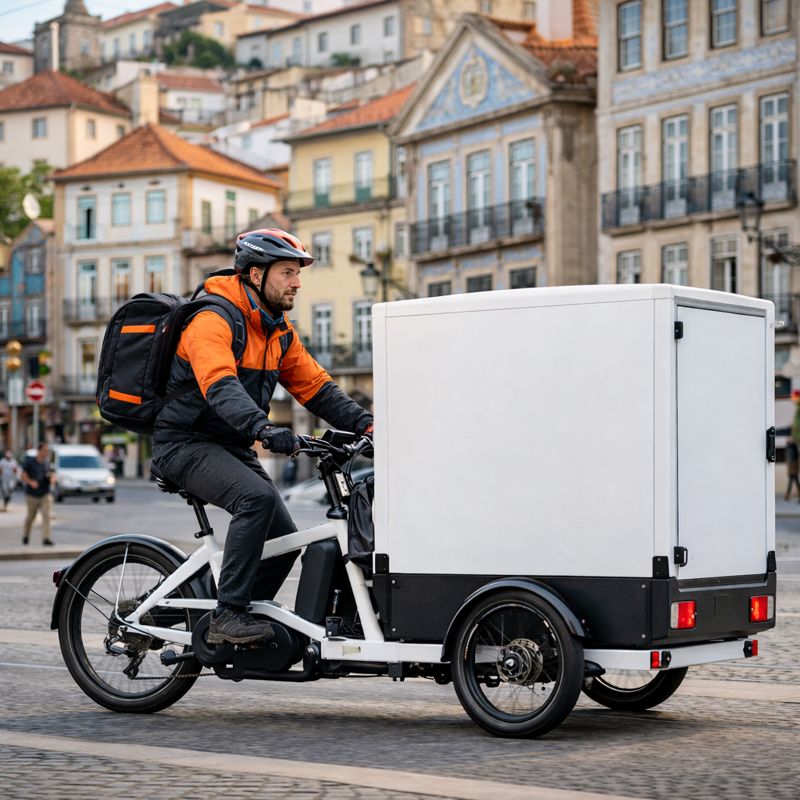
At the same time, Braga is undergoing a transition towards more sustainable urban logistics, including the adoption of low-emission delivery modes such as cargo bikes and electric vehicles.
The Solution
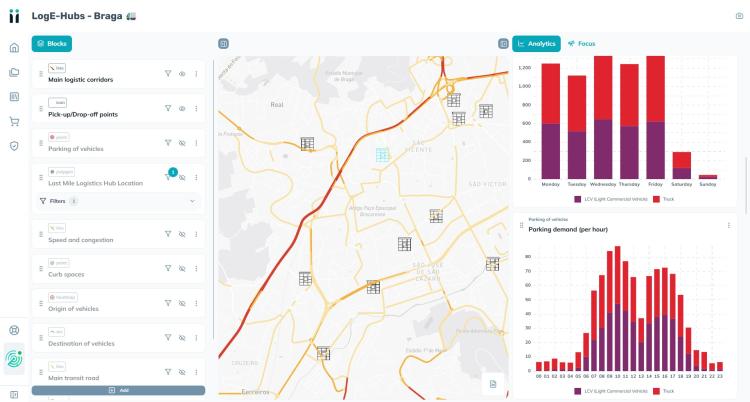
To address these challenges, Braga implemented the LogE-Hubs platform as a strategic decision-support tool for last-mile logistics planning in dense urban environments. The pilot focused on the historic centre and surrounding access corridors, with the objective of identifying optimal locations for logistics hubs and micro-hubs to support a shift towards more efficient and sustainable delivery systems.
The platform integrated floating car data from commercial vehicles with city-provided territorial datasets, including the road network, logistics infrastructure, cycling infrastructure and relevant urban constraints. All data were anonymised and aggregated in compliance with GDPR requirements. This enabled a consolidated view of logistics flows, stop patterns and accessibility conditions across the city centre.
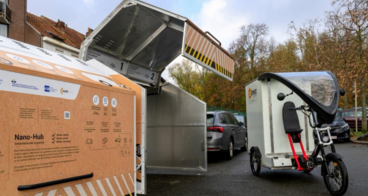
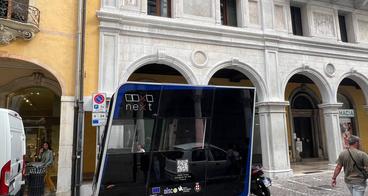
A key component of the solution was the multi-criteria logistics hub suitability analysis. This framework combined indicators such as proximity to logistics corridors, vehicle origin patterns, proximity to economic and industrial activity, accessibility to the city centre and alignment with cycling infrastructure. The analysis supported the differentiation between truck-to-cargo-bike transfer hubs and customer-facing infrastructure such as parcel lockers, enabling a more nuanced approach to last-mile logistics design.
Making an impact
The LogE-Hubs pilot provided Braga with a consolidated and spatially detailed understanding of last-mile logistics dynamics in its historic city centre. By combining mobility and territorial data, the municipality gained clearer visibility over logistics access corridors, delivery concentration areas and locations where freight activity generates congestion and public space conflicts.
A key impact of the pilot was the identification of optimal locations for logistics hubs and micro-hubs. The multi-criteria suitability analysis enabled the city to evaluate different types of infrastructure, including consolidation hubs for cargo-bike distribution and parcel lockers for end-consumer deliveries. This created a strong analytical basis for reducing truck penetration into the historic centre and improving the efficiency of last-mile operations.
The pilot also strengthened coordination between municipal departments, logistics operators and local stakeholders. Workshops involving the shop owners’ association revealed strong interest in the platform as a shared reference tool for discussing delivery coordination, time windows and the potential development of proximity-based logistics solutions. This helped establish a more structured dialogue between stakeholders with different priorities.
Lessons learnt
One of the main lessons from the Braga pilot was the importance of addressing stakeholder diversity early in the process. Retailers, municipal departments and logistics operators often have differing priorities regarding access, delivery efficiency and public space use. Structured workshops were essential to align expectations and build shared understanding of the problem and potential solutions.
A second key lesson was the importance of positioning the platform as a neutral, data-driven decision-support tool rather than an operational enforcement system. This positioning helped build trust among stakeholders and encouraged open discussion about sensitive topics such as delivery restrictions, access regulations and consolidation strategies in the historic centre.
The pilot also highlighted the value of explicitly differentiating logistics solutions based on urban function. Separating truck-to-cargo-bike transfer hubs from customer-facing parcel lockers allowed for more realistic and flexible planning approaches adapted to the constraints of historic environments.
Finally, the experience confirmed that dense historic cities require highly tailored logistics planning approaches. Space constraints, regulatory complexity and the transition to low-emission delivery systems must all be considered simultaneously. The Braga pilot demonstrated that data-driven tools can effectively support this transition when embedded in collaborative planning processes.