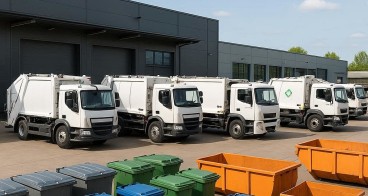


Optimising waste collection routes in Montana, Bulgaria

overflowing waste container
Supported by EIT Urban Mobility
The Challenge
Montana is a medium-sized municipality in north-western Bulgaria. Before the project, the city had installed fill-level sensors in waste containers, but the data was not effectively used in daily operations. Collection routes remained largely static, which resulted in avoidable vehicle kilometres, longer time on the road, higher fuel consumption and unnecessary emissions.
The project aimed to address this gap by transforming historical fill-rate data into operational intelligence. Using sensor data, containers were clustered according to their filling patterns, allowing the generation of optimised collection routes and schedules. This approach aimed to reduce driving distances and operational time while improving visibility of operational performance, including container status, vehicle movements, routes and traffic conditions.
Through this solution, Montana sought to improve service efficiency and cost control by reducing kilometres driven without compromising service quality or risking bin overflow. At the same time, the city aimed to lower fuel consumption and greenhouse-gas emissions, improve local air quality, and introduce a transparent, data-driven operational layer supporting better routing decisions and performance monitoring.
The Solution
ROSE is a route-optimisation module that integrates with existing Digital Waste Monitoring Platforms (DWMPs). It converts routine operational data into actionable decisions on which containers should be serviced, when they should be collected and which routes collection vehicles should follow.
The system analyses container locations and historical fill-level data to generate operational insights. Bins are grouped into geographic clusters and visualised through a Clusters Map, highlighting fill levels and priority areas. The Bin Placement Analysis module identified underused containers and areas with high demand, recommending relocation or redistribution to improve utilisation and reduce overflow risks. At the same time, the Schedule Optimisation function recreated the current “as-operated” routes as a baseline and predicted fill behaviour to adjust collection frequency, eliminating unnecessary pickups while ensuring service reliability.
These insights were combined to produce optimised collection schedules and routes for each cluster in Montana. The solution also provides impact analysis, quantifying potential savings in distance travelled, fuel consumption and emissions. By replacing static routing with data-driven planning based on bin locations and fill patterns, the system helps reduce kilometres travelled and time on the road while lowering fuel use, emissions, noise and operational disruption.
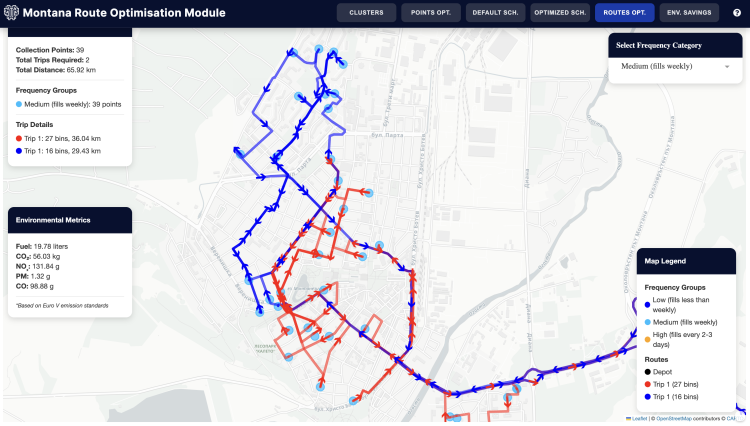
Adjusted courses for waste collection
Making an impact
The solution was validated in Montana using operational data from 80 mixed-use waste containers. By applying data-driven scheduling and route optimisation, the platform demonstrated that even a limited set of collection routes can generate measurable operational and environmental benefits.
On the routes analysed during the pilot, the solution reduced weekly driving distance by 6-10%, resulting in a proportional reduction in fuel consumption. Weekly CO₂ emissions decreased by up to 15 kg, illustrating how data-driven collection planning can contribute to lower operational costs and improved environmental performance.
The pilot also highlighted the potential of container-network optimisation. The analysis showed that two container locations could be relocated while maintaining service coverage, improving utilisation and reducing unnecessary servicing. These results suggest that significantly larger efficiency gains could be achieved if the approach were scaled across Montana’s wider container network, where aggregated distance, fuel and emissions savings would be substantially higher.
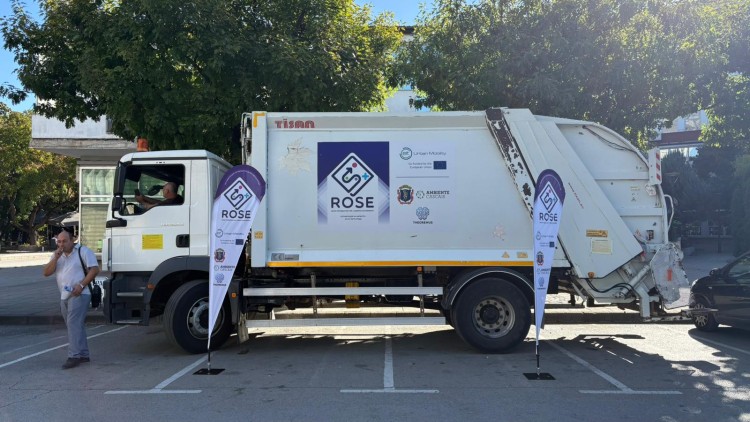
Montana pilot
Lessons learnt
A key lesson from the Montana pilot was the importance of ensuring reliable data inputs before deploying optimisation services. Data-driven solutions depend on the quality and continuity of underlying infrastructure, particularly fill-level sensors that provide the operational data used for route planning.
Although Montana already operated a sensor-based monitoring system, several sensors required verification before the optimisation platform could be effectively deployed. This involved checking battery levels, connectivity and data continuity to ensure that the sensor readings were accurate and consistent. The validation phase demonstrated that even established sensor networks can degrade over time if not regularly monitored.
The experience highlighted the need to treat sensor maintenance and data verification as a proactive operational practice rather than a reactive task. Ensuring the reliability of sensor infrastructure should therefore be considered a prerequisite for deploying data-driven optimisation services and scaling them across municipal waste systems.