

Improving safe interaction between automated buses and other road users
Supported by EIT Urban Mobility
The Challenge
Cities and public transport operators are increasingly aiming to make public transport safer, more accessible, inclusive, affordable, resilient, smart and emission-free. Autonomous buses are seen as a potential solution to support this transition, as they can improve operational efficiency, reduce emissions, optimise service provision and potentially lower operational costs compared to conventional bus systems.
In Stavanger and Rotterdam, one of the main challenges for deploying fully autonomous buses was replacing the interaction normally provided by the onboard safety driver. Human drivers often rely on eye contact and hand gestures to communicate with pedestrians, cyclists and other road users in situations where it is unclear whether it is safe to cross or pass.
Removing the safety driver therefore required new ways for autonomous buses to communicate their intentions safely and clearly without relying on Vehicle-to-Everything (V2X) communication systems. Ensuring safe interaction with other road users, while maintaining public trust and operational safety, remains a key challenge for the large-scale deployment of autonomous public transport.
At the same time, autonomous public transport services must meet strict safety and reliability requirements while complying with different regulatory frameworks across cities and countries.
The Solution
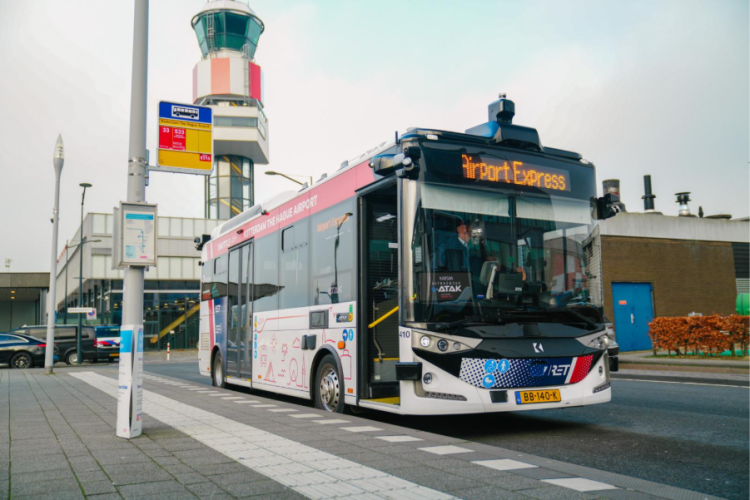
The solution focused on testing and deploying external Human-Machine Interaction (eHMI) systems on autonomous buses operating in real urban environments in Stavanger and Rotterdam.
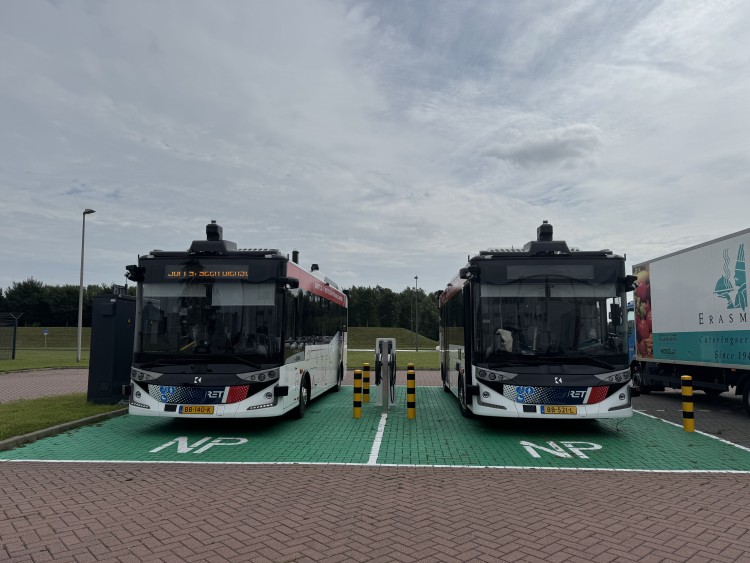
The project introduced external communication interfaces mounted on the front, sides and rear of the buses to improve interactions with pedestrians, cyclists and other road users. These interfaces used text-based communication to indicate when the bus had detected nearby road users and when it was safe to pass or cross. The solution aimed to replicate the reassurance and communication traditionally provided by human drivers through eye contact and gestures.
The autonomous buses were designed to operate more smoothly, predictably and safely than conventional buses, improving ride comfort and operational efficiency. The project also explored how autonomous public transport could support more flexible and resilient mobility services in the future, including on-demand operations and better integration with other transport modes.
In parallel, the project assessed the safety, usability and public acceptance of eHMI systems in real-world conditions, while working with local authorities and transport stakeholders to support regulatory approval and operational deployment.
Making an impact
The project demonstrated that autonomous buses equipped with eHMI systems could operate safely and reliably in real urban conditions while contributing to more sustainable public transport systems.
Since the start of operations in Stavanger and the deployment activities in Rotterdam, the autonomous bus services achieved over 98% operational availability for passengers, demonstrating a high level of reliability for day-to-day public transport operations.
From a safety perspective, the project reported zero accidents during autonomous driving operations on public roads, validating the robustness of both the autonomous driving systems and the supporting communication features.
The deployment also generated environmental benefits, with more than 6.7 tonnes of CO₂ emissions avoided compared to equivalent fossil-fuelled bus operations. This highlighted the contribution of autonomous electric buses to cleaner and more sustainable urban mobility systems.
In addition to the quantitative results, the project provided important validation for the use of external Human-Machine Interaction systems as a potential solution for improving communication between autonomous vehicles and other road users. The pilot also increased understanding of operational, regulatory and user acceptance requirements for future large-scale deployment of autonomous public transport services.
Lessons learnt
The project demonstrated that effective communication between autonomous buses and surrounding road users is essential for the safe deployment of driverless public transport services. One of the main lessons learned was that external Human-Machine Interaction (eHMI) systems require further standardisation and simplification to ensure messages are immediately understood by pedestrians, cyclists and drivers.
The consortium found that combining text, icons and colours in the eHMI displays sometimes created ambiguity for road users. Simpler and more intuitive communication methods will therefore be necessary for future deployments and broader public acceptance.
Another key lesson concerned vehicle integration. Retrofitting eHMI systems onto existing buses proved more complex than integrating them directly during vehicle production. This highlighted the importance of considering communication technologies early in vehicle design processes.
The project also showed that regulatory approval remains a major challenge for autonomous mobility deployment, as local and national authorities often apply different regulatory frameworks and safety requirements. Closer cooperation between cities, transport authorities and regulators will therefore be essential to accelerate future deployment.
Finally, the pilot confirmed that autonomous public transport can achieve high operational reliability and safety in real-world urban environments.